

** This article was written in collaboration with our youth stakeholders.
What is labeling – why it’s important
A label is a term used to describe someone’s gender identity or sexual orientation. Some common examples of labels include Bisexual, Lesbian, Gay, Pansexual, Transgender, Queer, or Nonbinary. Having a label can help a person feel a sense of belonging and some people may even feel as though they’ve found their true identity. Learning about and using labels can help an individual find comfort expressing themselves and can allow them to explore their attraction towards another. Labels can help others in the Queer community, as well as allies, to identify someone and understand their pronouns. A person can also meet others who share the same label and/or experiences.
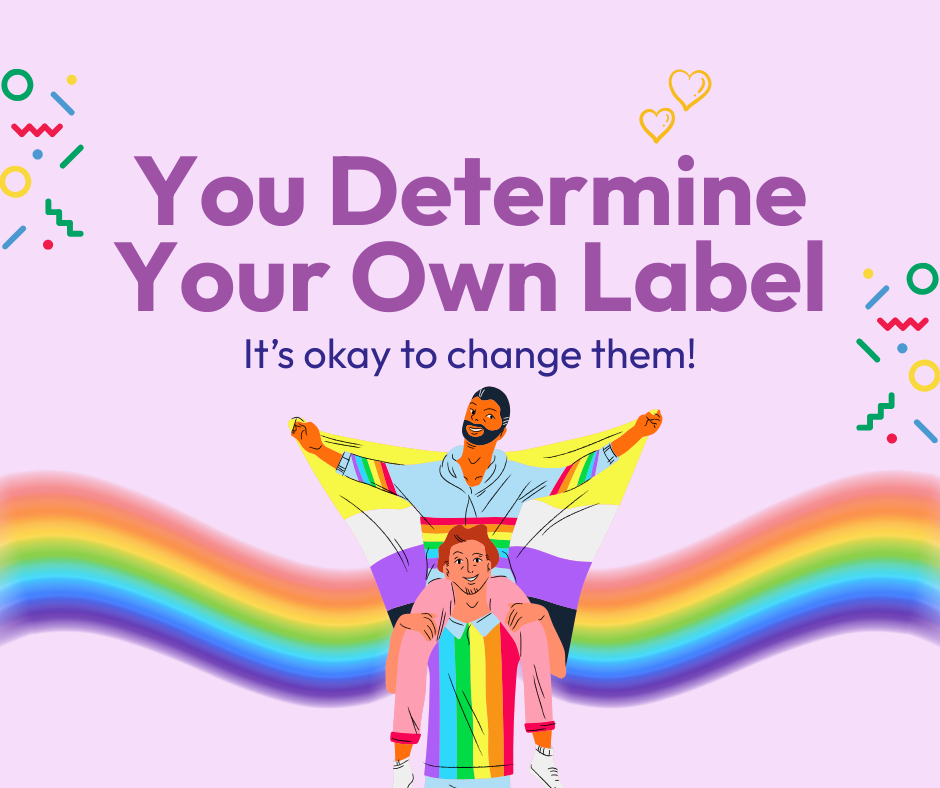
Labels are everchanging, with meanings that evolve over a period of time. With that being said, some may use one label, others may use multiple, and some choose not to use labels at all. If you can’t figure out a label that works for your, that’s okay, because the decision is yours to make! The Queer community shows that no matter how you identify or label yourself, you can be yourself and are accepted for who you are.
It’s okay to change your label
Identities are consistently in flux, if at one point in your life you labeled yourself a certain way and that identity no longer fits, it’s okay to break out of that mold. The change you’ve experienced is still significant because you are one step closer to becoming your most authentic self. Don’t let societal expectations of how to dress, behave, or express yourself persuade your identity or self-worth. These social pressures can cause us to doubt who we truly are or even make us feel like we need to stick with a specific definition – trapping us inside rigid notions of who we should be instead of who we are. When we hesitate to evolve our identities, we risk losing a part of ourselves.
If you once labeled yourself a certain way, and no longer do, it’s still significant! In the future, you may feel different about yourself compared to right now, or in another point in your life, and that’s okay. As a person grows older, you learn new things about yourself including concepts surrounding gender and sexuality. As language, and culture, evolve so do the labels people use to describe their gender or sexuality. Discovering the correct label to use can be challenging for someone who is in the beginning of their transition or trying to come out to their community.
Often times, people judge what they don’t understand and the pressure from others can affect us more than we think, it’s important to stay true to who you are. Don’t let others judgements or opinions change you. You don’t need to make the bounds of your labels more rigid.
Parents, or caregivers, here are some ways to support your teen going through gender transition
Give your child the freedom to express themselves in ways that feels comfortable to them! This change can come in the form of appearance – hair or clothing – or in other facets of life. A lack of understanding can cause a child to hesitate to take steps towards their self-discovery. While your child is undergoing their gender journey, become equipped with the tools to protect and defend them. For example, if someone speaks negatively about them, or their choice of expression, remind that person this is who your child is and this form of expression is what makes them happy.
Have an open discussion surrounding options for a child looking to discover their gender identity. This conversation can help the child become comfortable in talking to you about their journey, but also learning to trust themselves in their decision-making. For example, a non-permanent way to make a child more comfortable in their gender journey could be a chest binder. Both the guardians and youth can learn more about binders and proper binding techniques together to ensure the utmost safety, especially because unsafe binging techniques can lead to injuries.
Don’t bind more than 8 hours, don’t sleep in it, don’t swim with it on, no heavy excessive exercise, should not be painful, should be able to take a deep breath in it without straining
Parents, guardians, and caregivers can do many things to support their child going through gender transition. A youth going through gender transition can be challenging as is, a parent’s support can help them feel most comfortable in who they are. Through this support a child can feel comfortable in continuing to express themselves with no hesitation, stress, or judgement.